
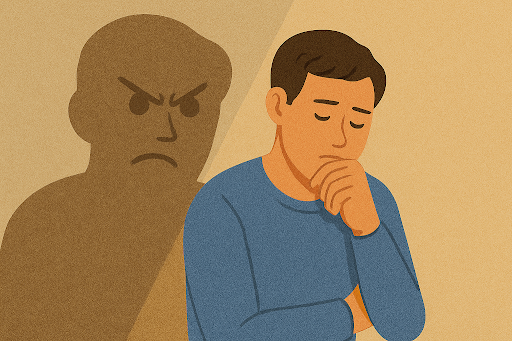
You sit down to finish something important—a project at work, a workout plan, a goal you’ve set. Halfway in, it hits you.
“Are you sure you’re doing this right?”
You pause. You second-guess everything. Maybe you start over. Or maybe you stop altogether.
That’s self-doubt. It’s quiet at first, then loud. It doesn’t care how smart you are or how many times you’ve succeeded. It shows up when the pressure’s on—especially when you want to do things right.
A lot of men carry this weight. We’re expected to figure things out, fix problems, lead well, and not mess up. So when we feel unsure, we keep it to ourselves and push through—alone.
But it doesn’t have to stay that way.
This blog is for anyone who’s heard that voice of doubt and wondered if they’re the only one. You’re not. We’ll look at how to spot the inner critic, what to do when it speaks up, and how to keep moving forward.
Jump to a Section
Understand the Voice in Your Head
The inner critic is that small voice that says, “You’re not good enough,” or “You’ll mess this up.” It shows up when you care most—when you’re stepping into something new, risky, or meaningful.
Maybe it hits during a job interview. You’ve prepared, dressed sharp, and walked in confident. But as soon as they ask the first question, doubt creeps in. “Did I say that right? Am I making sense? They probably think I’m unqualified.”
It’s wild how fast that voice can take over.
The inner critic isn’t based on truth. It’s driven by fear. It reminds you of past mistakes. It points out where you fall short. But it rarely gives the full picture.
Most people hear it—whether they talk about it or not. You’re not weak or broken for struggling with it. You’re human.
That voice might speak loud, but it doesn’t mean it’s right. You don’t have to believe everything you think. Not every doubt is based on fact. Some of it is just noise.
Recognizing that voice is the first step to quieting it. Once you know what it sounds like, you can stop giving it the mic.
Name the Lies—And Replace Them with Truth
Self-doubt doesn’t usually start with facts. It starts with lies.
“I’m not good enough.”
“Someone else would do this better.”
“I always screw things up.”
These thoughts sound real. They feel real. But that doesn’t make them true.
Lies are sneaky. They blend in with our own voice. They twist our past into a story of failure. And when we don’t challenge them, they grow.
Here’s the truth: Those thoughts are not from strength. They come from fear. And fear doesn’t deserve the final word.
Even Jesus said, “You will know the truth, and the truth will set you free.” (John 8:32, ESV) That’s not just about faith—it applies to how we think too.
A good way to push back is simple:
Write the lie. Then write the truth.
Try it.
Lie: I’m a terrible leader.
Truth: I care enough to lead well and I’m still learning.
Lie: I’ll probably fail again.
Truth: I’ve learned from my past, and I’m not the same guy I used to be.
You don’t have to silence every lie at once. Start with one. Speak truth over it. Say it out loud if you need to. Truth wins when you give it a voice.
Show Up Like an Athlete in a Slump
Even the best hitters in baseball go through slumps. They strike out. Miss easy pitches. Lose rhythm. It happens.
But here’s the thing—they still show up to the plate.
They don’t skip games. They don’t bench themselves. They trust the process and keep swinging.
That’s what you need to do when doubt creeps in.
You don’t need to feel strong to take the next step. You don’t need full confidence to keep going. You just need to show up.
Doubt hits hardest right before growth. That’s not a sign to stop. It’s a sign you’re stretching. Your comfort zone is shrinking. That’s good.
Consistency beats perfection. Every time.
The truth is, no one gets it right all the time. Not athletes. Not parents. Not leaders. Not you. Not me. That’s not the goal anyway.
You don’t need to be flawless. Just faithful.
Keep showing up. Even if you’re tired. Even if you’re unsure. Even if no one claps.
There’s a verse that says, “Let us not grow weary of doing good, for in due season we will reap, if we do not give up.” (Galatians 6:9, ESV)
Read that again.
Don’t give up.
Just keep stepping up to the plate.
Build a Culture of Encouragement
You weren’t made to do life alone. And you sure weren’t made to fight doubt alone.
When you start to question yourself, the voices around you matter. A lot.
Think about the people you trust most—friends, family, mentors, maybe your church group. They’re the ones who speak life when your own thoughts get dark. They remind you who you are when you forget. They see things in you that you don’t see in yourself.
That kind of support doesn’t just happen. You have to build it. You have to let people in.
Most guys stay quiet. We don’t want to seem weak, so we fake strength. But the truth is, real strength is being honest. Telling someone, “I’m stuck,” or “I’m doubting myself,” takes guts.
The right people won’t shame you. They’ll encourage you.
Not with fake cheerleading—but with reminders of your growth. With honest words like, “You’ve come this far. Don’t quit now.”
So ask yourself: Who in your life lifts you up? Who tells you the truth when you can’t see it?
Now flip it—who are you encouraging? Are you speaking life into anyone else?
Encouragement is a culture. It spreads when people live it out loud.
Build that kind of crew. And be that kind of friend.
Because when doubt shows up, it helps to have someone remind you, “Hey—you’ve got this.”
Take the Next Right Step
In football, a quarterback doesn’t try to throw a touchdown every play. That’s not how the game works.
Sometimes it’s a short pass. A simple handoff. A few yards forward.
Same goes for you.
When doubt hits, it’s easy to overthink everything. You freeze. You feel like you have to get it all perfect right now.
But the answer isn’t perfection—it’s progress. Just take the next right step.
Not ten steps. Not the whole game plan. Just one thing you know you can do today.
Send the email. Make the call. Open the book. Ask the question. Go for the walk. Write the sentence. Whatever your next step is—take it.
Those small moves add up. They build confidence. They train your brain to trust action over fear.
Waiting for the perfect moment will keep you stuck. But doing the next right thing? That’s how you move forward, even when your head’s a mess.
You don’t need to score big today.
Just move the ball.
Track the Wins—No Matter How Small
Self-doubt fades when you start noticing your growth.
Most people miss it. They focus on what’s left to do, not what’s already done.
But wins don’t have to be big to count.
Maybe you stayed calm in traffic. Finished a task you kept putting off. Spoke up in a hard conversation. That’s progress. That matters.
Here’s a simple way to fight doubt:
Keep a wins journal.
Write down one thing you did well each day. Just one. Doesn’t have to be deep. Just honest.
Over time, you’ll see a track record. You’ll remember that you’ve faced hard things and didn’t quit.
The small stuff stacks up. And when doubt tries to speak, you’ll have proof it’s wrong.
You’re doing better than you think. Start writing it down.
Remember: You Were Built for This
In basketball, players don’t start confident. They get confident through practice. Through game after game.
They miss shots. They lose games. But they keep playing. Each time, they get better.
You’re the same way.
You’ve faced hard things before. Maybe you didn’t feel ready then either. But you made it through.
This moment isn’t new. It’s part of your story.
You were created on purpose, for a purpose. “For we are his workmanship, created in Christ Jesus for good works, which God prepared beforehand.” (Ephesians 2:10, ESV)
That’s more than just a nice thought. It’s a reminder that you’re equipped for the challenges ahead—even when you don’t feel ready.
Confidence comes from doing, not waiting. From stepping up, not standing still.
So don’t wait until you feel perfect. Start now.
You’ve got what it takes. You’re built for this.
Let Your Actions Speak Louder Than Doubt
Doubt is real. It shows up for everyone. But it doesn’t get to lead your story.
When the voice says, “You can’t,” choose to move anyway. Take the next right step.
Keep showing up. Be consistent. Find courage in small wins. Lean on people who lift you up.
The inner critic might always whisper. But your actions speak louder.
Keep moving forward. You’re stronger than you think.